
Once he’s gazed upon her, a man is forever changed
– Lord Huron
the bravest men return with darkened hearts and phantom pain
Queensland – June/July 1997
Alison had always been a bit of a tomboy, a label she wore with pride. Growing up, she’d been the girl who’d rather climb trees than play with dolls, and that spirit carried her into adulthood. Now, as a full-time biology student at the University of New South Wales (UNSW), she balanced her academic life with a passion for physical challenges and competition. This drive led her to join the army reserve, specifically a Medical Corps unit based in the inner Sydney suburb of Randwick. The location was ideal—close to her student accommodation, her part-time job, and the UNSW campus. The reserves offered her a chance to push her limits, embrace new experiences, and indulge her love for sports and camaraderie.
The training in the army was worlds apart from anything Alison had encountered before. The physical demands were intense, but she thrived on the discipline, the sweat, and the sense of purpose it instilled. The camaraderie was unlike anything she’d known, a bond forged through shared challenges and mutual reliance. While the Medical Corps had a fair share of women, the broader reserve was undeniably male-dominated. Alison didn’t mind. She enjoyed the company of men, their straightforward humour, and the easy banter that came with it. But that didn’t mean she wasn’t interested in them romantically. In fact, the reserves were, as her friend Lisa often put it, a “target-rich environment.”
When the girls in her unit had downtime, tucked away in their tents or barracks, the conversation inevitably turned to the men in their company. It was classic “girl talk,” filled with speculation, and playful debates about which soldier was the most attractive. Alison, only a couple of years out of her all-girls high school, relished this newfound freedom. Living away from home for the first time, she could finally make her own choices—how much to study, how hard to train, and, yes, whom to flirt with. The world felt like a buffet of possibilities, and she was eager to sample it all.
As a full-time student, Alison had the flexibility to take on extra reserve training opportunities. So, when the chance came to spend two weeks at the Land Warfare Centre learning infantry minor tactics, she jumped at it without hesitation. The plan was for her brigade to send a rifle company to the LWC, and Alison was thrilled to learn she’d be playing the role of a rifleman for the duration, not a medic. It was a chance to step outside her usual role and embrace a new challenge. Three others from her Medical Corps unit were also selected: Greg, who would serve as the company medic; Sue, who’d take on the role of a section commander; and Lisa, who, like Alison, would get to experience life as a rifleman.
The company spent two weekends preparing at the Engineer Barracks in Penrith, just west of Sydney. The training was gruelling, focusing on physical fitness, infantry drills, and fieldcraft. Alison soaked it all up, her enthusiasm infectious. The infantry guys assigned to guide them were patient and skilled, teaching her how to handle weapons with precision and move stealthily through varied terrain. She felt a thrill every time she mastered a new skill, whether it was dismantling a rifle or reading the landscape for tactical advantage. The physicality of it all—sprinting through obstacle courses, crawling through mud, and carrying heavy packs—made her feel alive in a way her biology textbooks never could.
Leading the soldiers were two officers: Second Lieutenant Hochmann and Lieutenant Holland. Alison quickly formed impressions of both. 2Lt. Hochmann was the quintessential Australian bloke—loud, confident, and unapologetically alpha. He led with a swagger, his voice booming across the barracks as he issued orders. Lt. Holland was quieter, more reserved. His soft-spoken demeanour and thoughtful approach made him seem almost out of place in the rough-and-tumble world of infantry training. Alison found herself intrigued by the contrast, but didn’t dwell on it. Her focus was on the training, the challenge, and the adventure ahead.
The journey to Queensland was an adventure in itself. The company flew out of Richmond Air Force Base in the back of a Royal Australian Air Force transport plane. The hold was deafening, the roar of the engines drowning out all but the loudest shouts. Alison didn’t care. The excitement of what lay ahead—two weeks in the jungle, learning infantry tactics—kept her buzzing with energy. The two-hour flight passed in a blur, her mind racing with anticipation.
When they landed, a bus took them to the LWC at Canungra, nestled high in the mountains overlooking the glittering beaches of the Gold Coast. The contrast between the dense jungle and the distant sparkle of the ocean was striking. Their accommodation was spartan—rows of canvas tents with creaky, ancient-looking camp beds that seemed straight out of a World War II museum. But Alison had learned in her two years with the reserves that any bed, no matter how rickety, was a luxury compared to sleeping on the ground. She settled in with a grin, ready for whatever the next two weeks would bring.
The days at Canungra were packed with training. Mornings started with physical training (PT) sessions that left her muscles aching but her spirits high. The instructors, seasoned infantry soldiers from the LWC, drilled them in weapons handling, navigation, and small-unit tactics. Alison threw herself into it, relishing the chance to learn skills she’d never imagined needing as a medic. She made new friends within the company, their shared exhaustion and triumphs forging quick bonds. And, as a bonus, she was getting paid to do it—a fact that never failed to make her smile.
Each evening, the women in the company retreated to their tent, a small oasis of femininity in that male-dominated world. They’d sprawl on their camp beds, swapping stories about the day’s training, laughing over fumbled drills or the instructors’ dry humour. Inevitably, Lisa would steer the conversation toward the men in the company. She was relentless, her eyes lighting up as she talked about Tony, a lanky infantryman with a quick wit. Lisa seemed determined to “score” before the training ended, and Tony was her target. The other women humoured her, but after a few nights, her obsession grew repetitive. Sensing their waning interest, Lisa tried to draw them in, asking if they had crushes of their own. Alison offered vague, noncommittal answers, content to let Lisa dominate the conversation.
But one night, Sue surprised them both by saying, “Lt. Holland.”
Alison blinked, surprised. Lt. Holland? They’d barely seen him since arriving at Canungra. The LWC staff ran most of the training, while the officers, including Hochmann and Holland, were off doing their own specialised courses during the day. She saw them only during morning PT, evening briefings, or the occasional passing moment around the camp. 2Lt. Hochmann was always front and centre, his larger-than-life presence impossible to ignore. Lt. Holland seemed to fade into the background, quiet and observant, stepping in only when necessary. Alison hadn’t given him much thought until Sue’s comment planted a seed of curiosity.
In the days that followed, Alison noticed Lt. Holland more. When 2Lt. Hochmann led; he was all bravado, his confidence bordering on arrogance. Lt. Holland had an understated authority that intrigued her. He didn’t need to shout to command attention; his calm, deliberate manner drew people in. Alison wondered what lay beneath his reserved exterior. Each night, as she lay in her creaky camp bed, her thoughts drifted to him—not romantically, she told herself, but out of curiosity. Who was he when he wasn’t playing the role of an officer? What drove him?
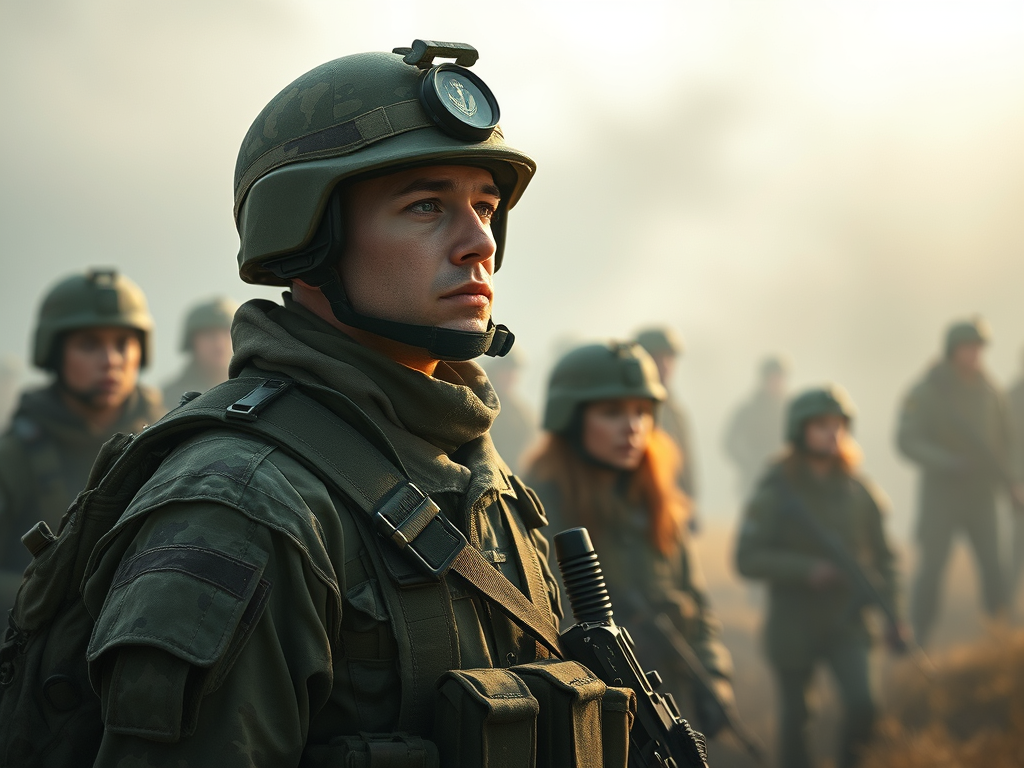
The second week of training took the company to the Border Ranges, a dense mountain rainforest straddling the Queensland-New South Wales border. The field phase was a stark departure from the structured environment of Canungra. Here, the terrain was unforgiving—steep, muddy slopes, tangled vines, and air so humid it felt like breathing soup. Alison, now fully immersed in her role as a rifleman, found the experience both exhilarating and exhausting. The tactical exercises demanded constant vigilance, with the company moving in silence or hushed whispers to avoid detection. Her world shrank to her section, often just one or two faces for hours at a time. She learned to read the jungle, to move without leaving a trace, and to trust her instincts.
2Lt. Hochmann was a constant presence, even if he was silenced by tactical necessity. Alison noticed him watching her occasionally, his expression unreadable. As a newcomer to the infantry, she wondered if she’d made a mistake—perhaps her inexperience showed. The thought nagged at her, but she pushed it aside, focusing on the task at hand.

By the fifth night, the novelty of the field phase had worn thin. Alison missed the bustle of her medic role, the chatter of headquarters, and the comfort of a dry tent. The jungle was beautiful but relentless, and the constant whispering and isolation were wearing on her. She longed for a proper conversation, a hot meal, and a bed that wasn’t composed of tree roots and mud.
On the last night, the platoon returned to company headquarters to prepare for their move back to Canungra. As they approached, Alison spotted Lt. Holland standing at the edge of the clearing, waiting to guide them into position. His face, streaked with camouflage paint and stubble, illuminated only by the last rays of the dying sun. For reasons she couldn’t explain, her heart skipped a beat. Maybe it was exhaustion, or the relief of seeing a familiar face after days of isolation, but something about him in that moment struck her. Then he smiled—a rare, genuine smile that lit up his eyes. Alison felt a warmth spread through her, a flutter she hadn’t expected. From that moment until they returned to camp, she couldn’t stop stealing glances at him. The jungle, the training, the exhaustion—it all faded away. For the first time in days, the world felt vibrant again, and Lt. Holland was at the centre.



Leave a Reply